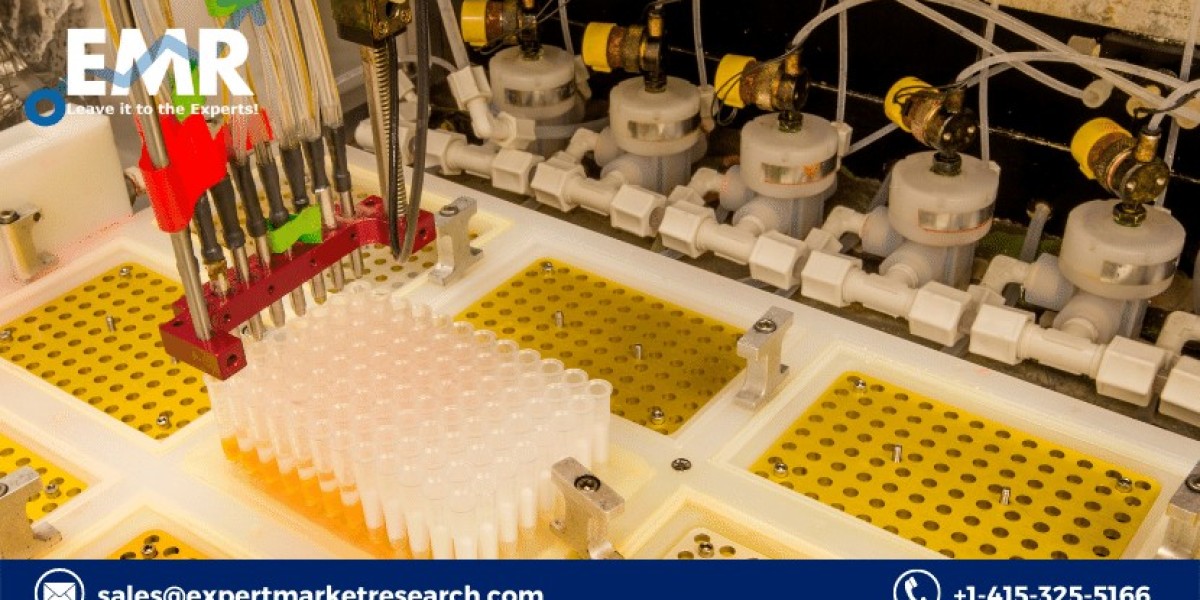

Automated Liquid Handling Market Introduction
The global automated liquid handling market attained a value of about USD 1061.29 million in 2023. The market is further expected to grow in the forecast period of 2024-2032 at a CAGR of 8.6% to reach nearly USD 2230.11 million by 2032.
As industries and research laboratories strive for greater efficiency, accuracy, and throughput, the integration of artificial intelligence (AI) and machine learning (ML) into liquid handling automation systems has become increasingly prevalent. This blog post delves into the pivotal role that AI and ML play in shaping the future of liquid handling automation.
Understanding AI and Machine Learning in Liquid Handling Automation
To comprehend the significance of AI and ML in liquid handling automation, it is essential to grasp the fundamentals of these technologies. Artificial intelligence refers to the simulation of human intelligence processes by machines, enabling them to perform tasks that typically require human intelligence, such as learning, problem-solving, and decision-making. Machine learning, a subset of AI, empowers systems to learn from data and improve their performance over time without explicit programming.
In the context of liquid handling automation, AI and ML algorithms are leveraged to enhance precision, accuracy, and efficiency. These technologies enable liquid handling systems to adapt to dynamic environments, optimize workflows, and detect and mitigate errors in real-time.
Get a Free Sample Report with Table of Contents@https://www.expertmarketresearch.com/reports/automated-liquid-handling-market/requestsample
Advantages of AI and Machine Learning in Liquid Handling Automation
The incorporation of AI and ML brings numerous advantages to liquid handling automation processes. Firstly, AI-driven liquid handling systems offer unparalleled precision and accuracy in pipetting, minimizing errors and variability in experimental results. ML algorithms can analyze vast datasets to identify patterns and optimize liquid handling protocols for maximum efficiency and reproducibility.
Moreover, AI-powered liquid handling platforms possess adaptive learning capabilities, allowing them to continuously refine their performance based on feedback and experience. This adaptability is particularly valuable in research and development settings where experimental conditions may vary, enabling scientists to achieve consistent and reliable outcomes.
Applications of AI and Machine Learning in Liquid Handling
The applications of AI and ML in liquid handling automation span across various industries and disciplines. In drug discovery and development, for instance, AI-driven liquid handling systems facilitate high-throughput screening of compound libraries, accelerating the identification of potential drug candidates. ML algorithms analyze screening data to prioritize promising compounds for further evaluation, streamlining the drug discovery process.
Similarly, in clinical diagnostics, AI-enabled liquid handling platforms enhance the accuracy and efficiency of diagnostic tests, enabling healthcare professionals to make timely and informed decisions. By automating sample preparation and analysis, these systems reduce turnaround times and improve patient outcomes.
Challenges and Considerations
Despite the numerous benefits of AI and ML in liquid handling automation, several challenges and considerations must be addressed. Data privacy and security concerns arise from the vast amounts of sensitive data generated and processed by AI-driven systems. Safeguarding against data breaches and unauthorized access is paramount to maintaining the integrity and confidentiality of research and clinical data.
Integration with existing laboratory infrastructure poses another challenge, as AI-driven liquid handling systems must seamlessly integrate with other laboratory instruments and software platforms. Compatibility issues and interoperability constraints may hinder the adoption and deployment of these technologies, necessitating robust integration solutions and standardized protocols.
Furthermore, the successful implementation of AI and ML in liquid handling automation requires specialized expertise and training. Scientists and laboratory technicians must possess the requisite skills to develop, deploy, and maintain AI-driven systems effectively. Investing in training programs and professional development initiatives is crucial to building a skilled workforce capable of harnessing the full potential of these technologies.
Future Outlook and Trends
Looking ahead, the future of liquid handling automation is brimming with possibilities fueled by AI and ML innovations. Advances in AI-driven robotics and sensor technologies will enable the development of next-generation liquid handling systems capable of performing complex manipulations with unprecedented speed and precision. Integration with emerging technologies such as robotics, Internet of Things (IoT), and cloud computing will further enhance the capabilities and versatility of liquid handling platforms, paving the way for new applications and discoveries in life sciences and beyond.
Media Contact:
Company Name: Claight Corporation
Contact Person: Louis Wane, Corporate Sales Specialist U.S.A.
Email:sales@expertmarketresearch.com
Toll Free Number:+1-415-325-5166 | +44-702-402-5790
Address: 30 North Gould Street, Sheridan, WY 82801, USA
Website:https://www.expertmarketresearch.com